Psalm of the Apocalypse: God is With Her!
Psalm 46 announces from the get-go its theme and topic: the topic is God’s constant presence in trouble, and its theme is God’s ultimate reign and rule over chaos in our lives and in the world. In fact, it is the psalm of the apocalypse, and it claims that even if the entire earth gives way and is destroyed, God is in utter command over all.
In the beginning the psalmist announces his topic of God’s presence with us, “a very present help in trouble.” This help extends to rule over our emotional response to trouble: “we will not fear.” Following is a stack of metaphors for trouble, starting with the metaphor of the mountain giving way. It is an utter undoing of the order of creation, as on day 3 of creation God separated the sea and the dry land; He fixed a boundary where the chaotic sea would not impinge on the land He created for His crowning creation: man. Even though the mountain gives way, and even though dry land disappears and the floods swell and roar and foam, we will not fear, because God is a present “help in trouble”.
The next two verses contrast this metaphor of the roaring, foaming sea with the river of God. With personification, this river makes glad the city of God. In contrast to the chaos of creation undoing in the last two verses, the river nourishes a holy habitation in which God dwells with His people.. The movement of stormy seas is contrasted with the immovability and stability of this city: “God is in the midst of her; she shall not be moved.” This stillness culminates in the promise of God: “God will help her when morning dawns.” When the seas still, when the last mountain tremble is over, there is God, unmoved and unmoving, holding His people as the light of day breaks across the sky. The perfect morning of God’s peace that passes understanding outlasts every tumult in creation.
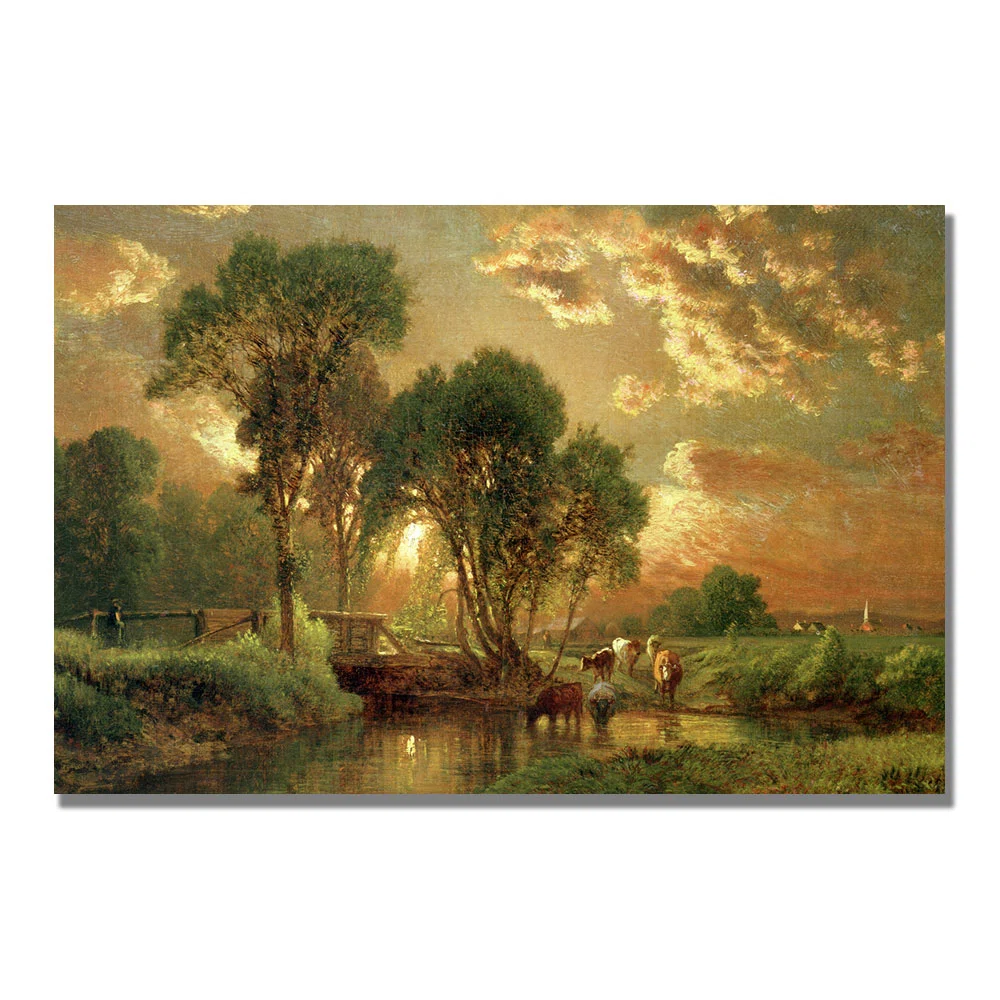
George Innes: Medfield Massachusetts
Not only is He in the midst of us in the utter chaos of nature’s undoing, but He is also there when the “nations rage, the kingdoms totter.” In this instance, nations and kingdoms are a personified synecdoche for the peoples of the earth that do not submit to Christ’s rule and reign, an image of human-agency evil and devastation. But in this case, He has only to utter His voice, and “the earth melts.” This is the final word on human evil, but as if this isn’t enough, we have a bookend of this section reminding us of our topic and theme. “The Lord of hosts (of armies) is with us; the God of Jacob is our fortress.” We begin and end this section with a fortress, but we should keep our finger on the image of the fortress. We will see it again.
Next we move to a command: we are bid to “Come, behold the works of the Lord.” These works include desolations brought by God on the earth. Oh, that we would remember God’s sovereign care in every circumstance. Not only is God with us in desolations, but He actually causes them in His purpose of ending human sin and evil. He brings wars to cease. He breaks the bow and shatters the spear, a metonymy for the agents of war. In this case, the bow and spear are representative of all human agents of war which God has brought to ruin. He burns the very chariots with fire. It is a stacking of stand-ins for the entire, complex, raging machinery of war. God has once and for all made it to cease.
Now God speaks directly to His people, the ones commanded to see His works, and we come to the crux of the Psalm. Here is what we are to do:
“Be still, and know that I am God.
I will be exalted among the nations,
I will be exalted in the earth.”
We march back in reverse order through the Psalm. God is steadfast, so we are to be still, to know and understand who God is. He is! Not only is He the God of our hearts, however, but He is the One who will be exalted. First, He will be exalted among the nations, the nations whose clamor never reaches above the sovereign dispatch of our God. Secondly, God will be exalted in the earth He made, bringing devastations to an end in His utter command.
The last couplet is almost an afterthought, but it brings us back to the beginning and to the middle image: God is with us. God is our fortress. And if this isn’t enough, the psalmist reminds us that God is the God of hosts, of armies at His command, and He is our personal Heavenly Father who calls us by name (Jacob) and who renames us (Israel): He is the God of Jacob, and He is our fortress. In the words of Isaiah, “I have called you by name, you are mine.”
