Sonnet John 15:12-17
In Exodus 3 and 4 we see a conversation between God, Yahweh, the God of Gods, King of Kings, Lord of Lords, and His servant Moses. He gives instructions to Moses concerning His planned rescue of the Israelite people, and appears to Moses in a burning bush that doesn’t burn up:
“Come, I will send you to Pharaoh that you may bring my people, the children of Israel, out of Egypt.” 11 But Moses said to God, “Who am I that I should go to Pharaoh and bring the children of Israel out of Egypt?” 12 He said, “But I will be with you, and this shall be the sign for you, that I have sent you: when you have brought the people out of Egypt, you shall serve God on this mountain.”
13 Then Moses said to Yahweh, “If I come to the people of Israel and say to them, ‘The God of your fathers has sent me to you,’ and they ask me, ‘What is his name?’ what shall I say to them?” 14 God said to Moses, “I am who I am.” And he said, “Say this to the people of Israel: ‘I am has sent me to you.’” 15 God also said to Moses, “Say this to the people of Israel: ‘The Lord, the God of your fathers, the God of Abraham, the God of Isaac, and the God of Jacob, has sent me to you.’ This is my name forever, and thus I am to be remembered throughout all generations….
But Moses said to the Lord, “Oh, my Adonai, I am not eloquent, either in the past or since you have spoken to your servant, but I am slow of speech and of tongue.” 11 Then the Lord said to him, “Who has made man's mouth? Who makes him mute, or deaf, or seeing, or blind? Is it not I, the Lord? 12 Now therefore go, and I will be with your mouth and teach you what you shall speak.” 13 But he said, “Oh, my Adonai, please send someone else.” 14 Then the anger of the Lord was kindled against Moses and he said, “Is there not Aaron, your brother, the Levite? I know that he can speak well. Behold, he is coming out to meet you, and when he sees you, he will be glad in his heart. 15 You shall speak to him and put the words in his mouth, and I will be with your mouth and with his mouth and will teach you both what to do. 16 He shall speak for you to the people, and he shall be your mouth, and you shall be as God to him. 17 And take in your hand this staff, with which you shall do the signs.”
Moses, ignoring God’s commanding presence, His burning bush appearance and His Holy Name revealed to him as “I Am that I Am,” chooses to address God as a servile servant addressing a master, questioning God’s power, authority, Presence, and ability to sustain and uphold him. He isn’t seeing God’s kindness, goodness, and power to rescue His people. Contrast this with Christ’s address to his disciples in the upper room, in which he calls his disciples no longer servants—servile, cringing, and incapable servants—but friends to whom He has chosen to reveal Himself in the flesh and in glory. Not only does He offer the utmost to His children, but He also chooses to address us in sonnet form! Check it out!
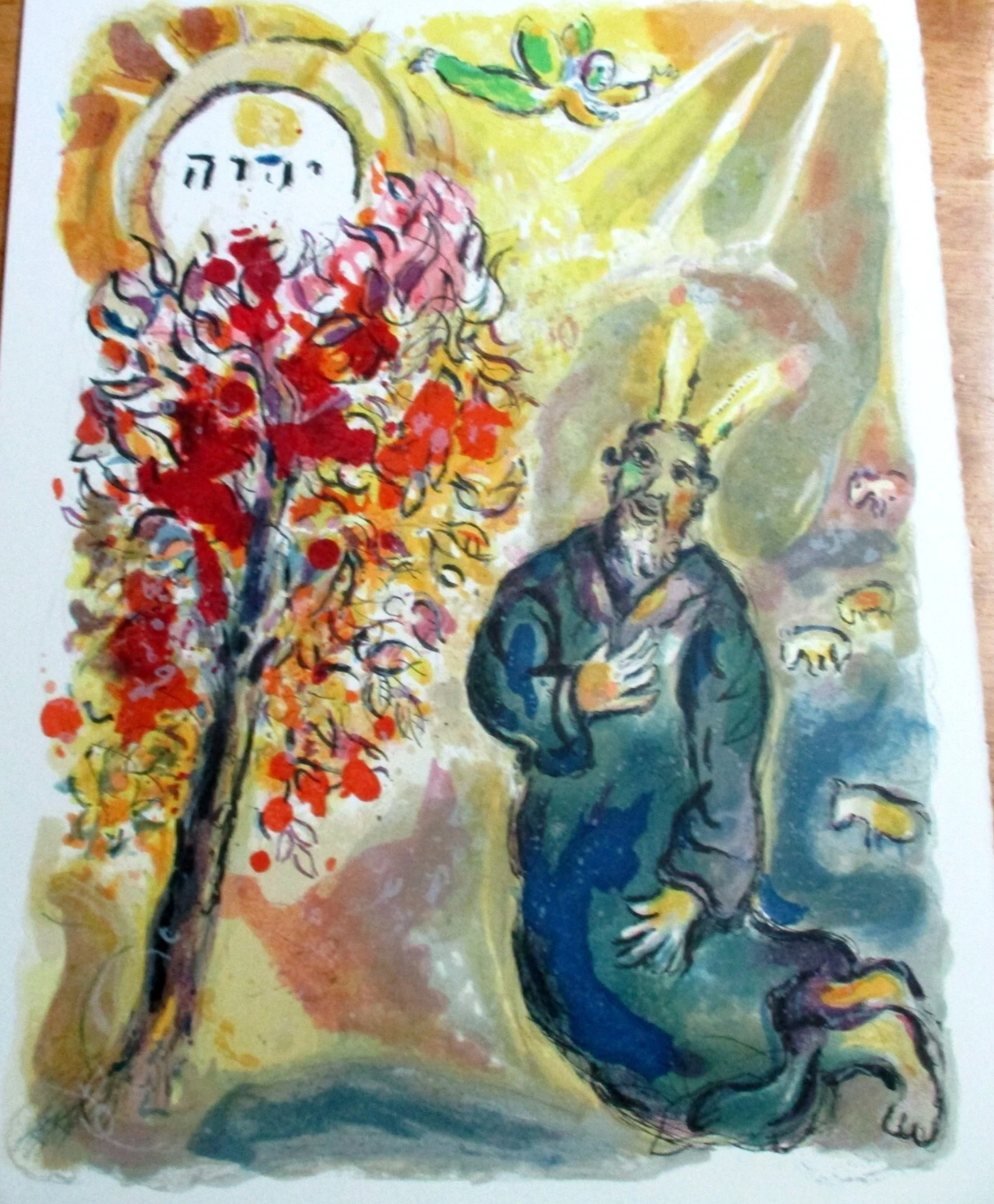
Marc Chagall
Sonnet John 15:12-17
This is my commandment that you love one another
As I have loved you.
Greater love has no man than this
That He lay down His life for His friends.
You are my friends if you do what I command you.
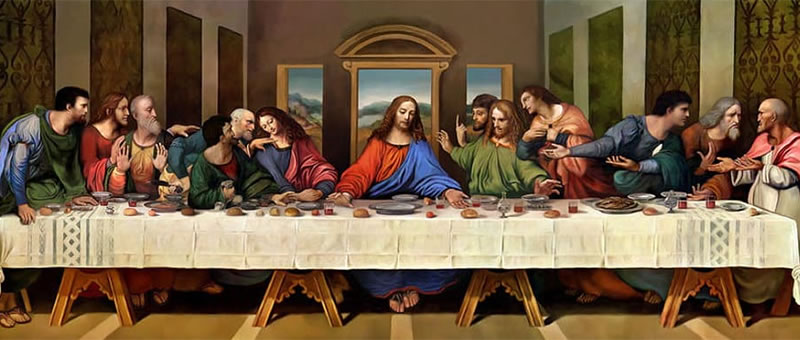
Last Supper, da Vinci
I no longer call you servants, for a
servant doesn’t know what his master is doing;
But I have called you friends, for all
That I have heard from the Father
I have made known to you.
You did not choose me,
But I chose you and appointed you
That you should go and bear fruit
And that your fruit should abide
So that whatever you ask the Father in my Name
He may give it to you.
These things I command you,
So that you will love one another.
The chiastic structure can jump out at us with the inclusio of the command to love at the beginning reiterated at the end, with “all that I heard from the Father I made known to you” as the meat in the middle. Not only do we have that chiasmus, but there is chiasmus in the first stanza with Christ laying down His life for his friends in the middle and command/command as the beginning and end inclusio of that stanza. In addition, the entire structure is framed on contrast. One obvious example is “you did not choose me but I chose you that you should bear much fruit and that your fruit should abide.” You/me, I/You and You/fruit, fruit/abide. It is packed with one-liner reversals. If we look at the themes as a kind of rhyme, with repeating themes as the rhyme scheme, the passage falls into a sonnet form with three four-line stanzas and a rhyming couplet at the end: These things I command you/So that you will love one another. It falls into the Elizabethan structure we love so well, with the packing-punch ending that falls into simplicity like a breath. The next time you doubt God’s Word, remember the sheer volume of poetry that never runs dry at our hands, ready to pick up. We never run out of new insight in God’s Word; He breathes it ever new each time we pick it up. Praise Him. Alleluia.
