The Once-for-All and Future King
Michael Ward has seasoned our understanding of the Narnia series with a comprehensive look at the image-laden landscape behind C. S. Lewis’ imagined world: that of the medieval planets taking their place in a sanctified imagination to offer us a deeper, richer view of God’s salvation.
Listening to the Holst Planets as played at Wheaton College last night by the Wheaton College Symphony Orchestra, now in its 100th year, I was struck again by the deep connection this piece has with the healing of Europe after WWI, and looking forward in time on into the nightmare and restoration of the Holocaust, the birth of Israel, and the mending of Europe after WWII. That Holst was deeply stirred by the savagery of WWI, and that he longed to fight for his country we know from his written record. We also know that C. S. Lewis resonated with Holst’s Planets. Kept in England due to myopia and neuralgia, Holst describes a birth of song in the midst of the war, (during the year he was writing Mars: Bringer of War, Venus: Bringer of Peace, and Jupiter: Bringer of Jollity) as he soldiered on in his own small sphere: composing music for a war-torn Britain:
It was a feast—an orgy. Four whole days of perpetual singing and playing, either properly arranged in the church or impromptu in various houses or still more impromptu in ploughed fields during thunderstorms, or in the train going home.It has been a revelation to me. And what has been revealed to me and what I shall never be able to persuade you is that quantity is more important than quality.We don’t get enough. We practice stuff for a concert at which we do a thing once and get excited over it and then go off and do something else.In the intervals between the services people drifted into church and sang motets or played violin or cello. And others caught bad colds through going long walks in the pouring rain singing madrigals and folk songs and rounds the whole time. The effect on us all was indescribable...Most people are overcome by mountain air at first. In the same way others are excited by certain music.The remedy in both cases is to have more and more and MORE.One of the advantages of being over forty is that one begins to learn the difference between knowing and realizing.I realize now why the Bible insists on heaven being a place (I should call it a condition) where people sing and go on singing (Letter to Ralph Vaughan Williams, 1914).
The weak and suffering Holst was allowed to go to the war theater towards the very end of WWI, working vigorously to create music amongst the soldiers demobilizing in Greece.
Lewis also fought his war, both on the battlefields of WWI as well as in the wrestling of the heart “restless” unless it “finds itself” in God’s grace. Finding in Christ the source of true myth, he turned his hand to exploring all these mythic contexts in the light of the one true myth. Much has been written about the shared vision of the Inklings, but Michael Ward has unpacked the treasure trove of imagination that Lewis has given us in the Narnia stories, with each Narnia story embodying a different planetary influence, all brought under the lordship of Christ as described in the imagined symbolism of Jupiter, representing our great God.
Wheaton College’s symphony orchestra plans to make a trip to the land of Lewis in May of 2026, armed with pieces from Lewis’ world in celebration of both the 100th year of the WCSO and the 75th anniversary of the publication of The Lion, the Witch, and the Wardrobe. Playing Holst’s Planets and thinking of Ward’s exposition of Lewis’ medieval planetary landscape, we can dig into the story of The Lion, the Witch, and the Wardrobe as the embodiment both of Christ’s salvific work and the old planetary understanding of Jupiter, described in Holst’s title as “Jove, the bringer of jollity.” I highly recommend reading Michael Ward’s popular work on this topic: Narnia Code: C. S. Lewis and the Secret of the Seven Heavens, published by Tyndale House Publishers and listening to Holst’s Planets simultaneously.
Here Lewis describes the influence of Jupiter in his poem “The Planets”:
…Soft breathes the air
Mild, and meadowy, as we mount further
Where rippled radiance rolls about us
Moved with music – measureless the waves’
Joy and jubilee. It is JOVE’s orbit,
Filled and festal, faster turning
With arc ampler. From the Isles of Tin
Tyrian traders, in trouble steering
Came with his cargoes; the Cornish treasure
That his ray ripens. Of wrath ended
And woes mended, of winter passed
And guilt forgiven, and good fortune
Jove is master; and of jocund revel,
Laughter of ladies. The lion-hearted,
The myriad-minded, men like the gods,
Helps and heroes, helms of nations
Just and gentle, are Jove’s children,
Work his wonders. On his white forehead
Calm and kingly, no care darkens
Nor wrath wrinkles: but righteous power
And leisure and largess their loose splendours
Have wrapped around him – a rich mantle
Of ease and empire…
And here is my poetic encapsulation of what Ward describes of Jove in The Lion, the Witch, and the Wardrobe, written after listening to the Wheaton College Symphony Orchestra rendition on an unseasonably balmy November 1, 2025.
Jupiter, First Offering
In the beechy glade
the water droplets gleam--
a rustling forest comes alive.
The frost gathers,
glistens
darting birds begin to sing.
As boy bares his head
the crocus leaps,
the chain is jerked
and nature seems to waiver--
will the stain-spotted mar be borne
upon that tree?
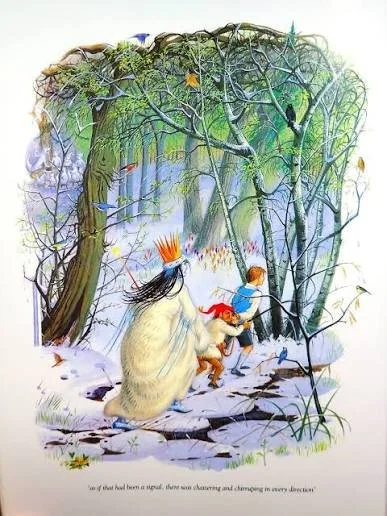
Will the chains be broken, and the
Mar de-blot?
Or always winter,
and never Christmas?
Here in and through the looking glass,
the wardrobe never sere,
a brighter image shines:
Where Aslan roars,
and leaping into the void,
the waters crash--
and tumble--
and sin takes its stumble,
dead upon that death
Through the needle's eye
(In the knife-glade,
willingly under the knife-blade
for all us knight-knaves, mustachioed lions all)
He has conquered death by death
and--He has given breath by breath:
winter melts into the gracious spring
when Aslan comes again.
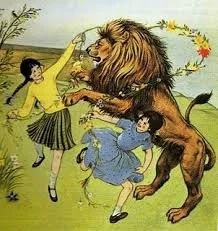
In the festooned cascade
Kingfishers catch fire--
thrice-freed children on the dais,
the true king resplendent
pacing His far domains.
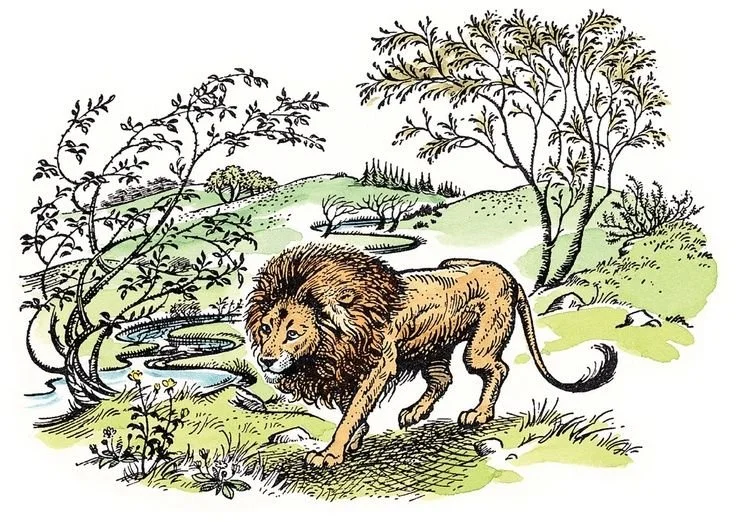
Oh taste and see, children,
that He is good,
Blessed is the man--
(no-one will be condemned
who takes refuge in Him)
Not tame, the waves breaking
on that further shore,
but He is good.
Return, my children, and begin to reign.

